

What separates a game you forget in a week from one you remember for years? It’s not just graphics, budget, or even story. The difference lies in deeper design principles that shape how a game feels moment to moment. Many players instinctively know when something clicks—but struggle to explain why. This article breaks down the essential elements that transform average titles into unforgettable experiences. Drawing from extensive analysis across casual games and high-level competitive play, we present a clear four-part model you can use to evaluate and better understand the games you love.
Core Mechanics: The Foundational ‘Verbs’ of Play’
At their simplest, games run on actions. Jumping in Mario. Shooting in Valorant. Building in Minecraft. These primary actions—often called core game mechanics—are the verbs players repeat thousands of times. If they feel good, the game thrives. If they feel clunky, no amount of flashy graphics can save it (we’ve all rage-quit one of those).
First, let’s define terms. A mechanic is a rule-driven action a player can perform. The game feel is the sensory feedback—animation, sound, controller vibration—that makes that action satisfying. Think of the bassy “thwump” of a perfectly timed jump or the crisp hit marker confirming a headshot. According to research on player immersion, responsive feedback loops significantly increase engagement (Sweetser & Wyeth, 2005).
However, not all mechanics are built the same. Some games offer:
- Few but deep mechanics (e.g., Rocket League aerial control)
- Many but shallow mechanics (quickly learned, quickly mastered)
Depth means a mechanic scales with skill. Complexity just means there’s more to memorize. Depth fuels higher skill ceilings—and longevity. It’s why decades later, players still optimize movement tech in classics.
In competitive scenes, precision is non-negotiable. Tight tuning ensures matches hinge on skill, not sluggish inputs. This directly ties into how risk and reward systems shape gameplay decisions.
Looking ahead, speculation suggests future esports titles will double down on hyper-refined mechanics, possibly integrating adaptive haptics and AI-driven responsiveness. If that happens, expect even tighter skill gaps—and even louder debates about balance.
Rules and Systems: The Invisible Architecture of Challenge
At first glance, rules look simple: don’t cheat, don’t glitch, don’t break the map. But beyond the obvious, rules function more like physics. They define gravity in a platformer, ammo scarcity in a shooter, or stamina drain in a boss fight. In other words, they shape the core game mechanics that determine what’s possible—and what’s risky.
For example, consider a roguelike where fire spreads between enemies and poison stacks over time. Separately, those systems are straightforward. Together? They create emergent gameplay—unexpected chain reactions no designer scripted. It’s like tossing Mentos into Coke and pretending you planned the geyser. To use this to your advantage, experiment deliberately: combine status effects, test environmental hazards, and observe patterns. The more interactions you catalog, the more tactical options you unlock.
However, some argue that strict systems limit creativity. Wouldn’t fewer constraints mean more freedom? Not necessarily. Balanced systems create meaningful decisions. In competitive games, one overpowered weapon can warp the entire meta (the dominant strategy landscape). According to game design research by Hunicke, LeBlanc, and Zubek (MDA Framework, 2004), mechanics directly shape player dynamics and overall experience. If one element dominates, strategy collapses.
So think of rules as grammar. First, learn the verbs—movement, timing, resource control. Then build sentences:
- Control space.
- Force reactions.
- Capitalize on cooldowns.
Master the grammar, and suddenly you’re not reacting—you’re composing.
Objectives & Feedback Loops: The Engine of Motivation
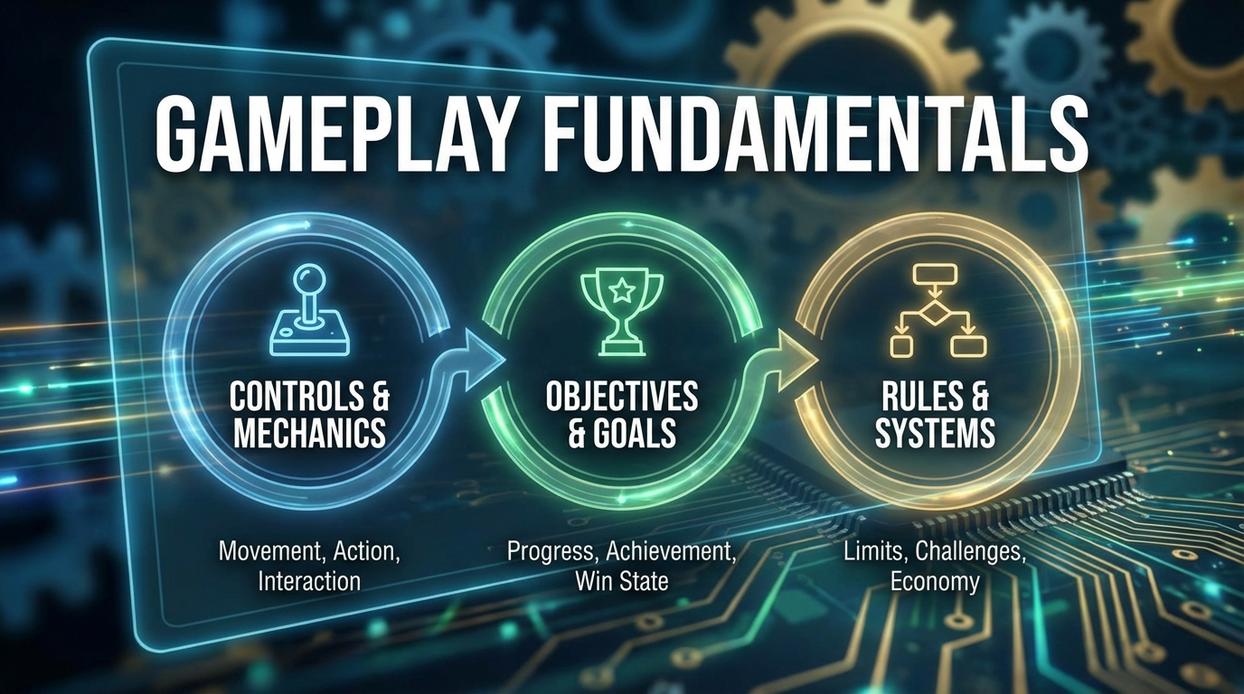
Giving Play a Purpose
Every great game starts with objectives—clear targets that guide action. Explicit goals are obvious: defeat the boss, capture the flag, reach level 50. Implicit goals are subtler: design the most beautiful farm or perfect your speedrun time. Both matter. Explicit goals drive progression; implicit goals fuel creativity and personal mastery. The benefit? You stay engaged longer because you’re not just finishing tasks—you’re expressing intent (and maybe a little pride).
The Core Loop
At the heart of all core game mechanics is a simple cycle: Player takes an action -> receives feedback -> makes a new decision. This loop is the heartbeat of engagement. When it runs smoothly, you feel momentum. When it breaks, frustration creeps in. Tight loops sharpen skills, improve reaction time, and build confidence—key advantages whether you’re grinding ranked matches or optimizing event tactics.
Reward Schedules
Games often use variable reward schedules—unpredictable rewards like random loot drops. Psychologists link this to anticipation spikes in dopamine activity (Schultz, 1997). Not knowing when the reward comes keeps you invested (yes, it’s the same principle behind slot machines). The upside? Sustained motivation and deeper focus during long sessions.
Clarity and Communication
Clear feedback is non-negotiable. Players must instantly understand outcomes:
- Did that hit connect?
- Was the jump mistimed?
- Did the strategy pay off?
When feedback is precise, improvement accelerates. You waste less time guessing and more time mastering. That’s the real win.
Player Agency and Control: The Feeling of Impact
Player agency is the capacity to make meaningful decisions that genuinely affect the game world. It’s the difference between watching a movie and holding the controller when the boss fight turns chaotic. If your choices don’t shift outcomes, you’re basically pressing buttons on a Netflix remote (and that’s not why we play).
A true choice changes your trajectory. Specializing in a skill tree that locks out other abilities forces commitment; it reshapes strategy, team roles, and late-game options. A false choice, like dialogue options that circle back to the same cutscene, is cosmetic. Developers sometimes argue that streamlined paths protect pacing. Fair. But without trade-offs, agency evaporates.
Control is the physical bridge. Responsive, low-latency inputs translate intent into action. If your jump fires milliseconds late, the illusion breaks. I recommend dialing in pro controller setups: map high-frequency actions to rear paddles, fine-tune deadzone calibration, and test sensitivity across different core game mechanics scenarios. Pro tip: lower deadzones carefully; too low invites drift.
Ultimately, agency enables skill expression—the unique fingerprint of how you play. Great competitive titles let players solve problems in distinct ways, whether that’s a stealth flank or a flashy combo straight out of an EVO highlight reel. If you want real impact, choose games that reward mastery, not autopilot. Demand systems that respect decisions. Fully.
From Player to Analyst: Seeing the Code Behind the Fun
You started with a simple question: why does one game hook you for hours while another falls flat? Now you have a clear lens to find the answer. By using Mechanics, Rules, Objectives, and Agency, you can break down any experience and replace that vague sense of “this is fun” with a precise understanding of why it works.
That frustration of not being able to explain great design is gone. You can now see the systems, predict engagement, and even anticipate which new releases will dominate.
Next time you boot up a game, apply the four-part model immediately. Analyze the loops. Test your agency. If you want deeper breakdowns, pro-level insights, and proven strategies trusted by competitive players, dive into our latest guides now and level up your game sense today.
 Ask Robertow Atkinselianz how they got into pro controller setup guides and you'll probably get a longer answer than you expected. The short version: Robertow started doing it, got genuinely hooked, and at some point realized they had accumulated enough hard-won knowledge that it would be a waste not to share it. So they started writing.
What makes Robertow worth reading is that they skips the obvious stuff. Nobody needs another surface-level take on Pro Controller Setup Guides, Event-Level Game Mod Tactics, eSports Strategy Breakdowns. What readers actually want is the nuance — the part that only becomes clear after you've made a few mistakes and figured out why. That's the territory Robertow operates in. The writing is direct, occasionally blunt, and always built around what's actually true rather than what sounds good in an article. They has little patience for filler, which means they's pieces tend to be denser with real information than the average post on the same subject.
Robertow doesn't write to impress anyone. They writes because they has things to say that they genuinely thinks people should hear. That motivation — basic as it sounds — produces something noticeably different from content written for clicks or word count. Readers pick up on it. The comments on Robertow's work tend to reflect that.
Ask Robertow Atkinselianz how they got into pro controller setup guides and you'll probably get a longer answer than you expected. The short version: Robertow started doing it, got genuinely hooked, and at some point realized they had accumulated enough hard-won knowledge that it would be a waste not to share it. So they started writing.
What makes Robertow worth reading is that they skips the obvious stuff. Nobody needs another surface-level take on Pro Controller Setup Guides, Event-Level Game Mod Tactics, eSports Strategy Breakdowns. What readers actually want is the nuance — the part that only becomes clear after you've made a few mistakes and figured out why. That's the territory Robertow operates in. The writing is direct, occasionally blunt, and always built around what's actually true rather than what sounds good in an article. They has little patience for filler, which means they's pieces tend to be denser with real information than the average post on the same subject.
Robertow doesn't write to impress anyone. They writes because they has things to say that they genuinely thinks people should hear. That motivation — basic as it sounds — produces something noticeably different from content written for clicks or word count. Readers pick up on it. The comments on Robertow's work tend to reflect that.